Showing posts with label Philosophy. Show all posts

Thursday, September 29, 2011

Instinct vs. Desire


After a long couple months dealing with my mother's death, I've started to put paint on canvas again. I decided to jump right in on a head study. I didn't take any process shots but this is about half finished and should show you how I go about painting. You can see the pencil sketch and the initial layers of paint. My goal was to force myself to be more loose and free with my painting, so I jumped right in without any tonal planning, correcting myself as I went along. It's the wrong way to paint, but it *did* force me to think and plan my brushstrokes.

I've always had a very slick style, tickling and stroking the paint until everything was blended and my brushstrokes were next to invisible. I would shoot colors into what was already on the canvas and blend it all out smooth. Lately I've been hating this style. I've been wanting my paintings to look like Repin, Manchess, Meseldzija, Duveneck, Loomis and countless others I'm forgetting. All of them apply paint in a controlled, loose way. Very thick and luscious. Your eye dances over their paintings and you forget to breathe. I'll never achieve their level of mastery, but that is my target.

I missed.

I intended this painting to look 'painterly'. Instead, I found myself reverting to my slick, blended 'style'. Every artist struggles to find their style, never thinking that it is always there waiting to come out when you aren't thinking about it. Style finds you when you're so engrossed in drawing that you forget to paint in a 'style'. Style is your instinct.

But what if your instinct isn't what you like? That's where I am. My instinctual style is blended. I desire it to be painterly. Should I force my style into what I want or should I relax and let it be what it is?

Monday, May 30, 2011

Self-Worth and the Artist

Everyone talks about having 'self-worth' or 'self-esteem' but I don't know that I've ever considered what that means to me. If I were to identify myself as something, it's as an artist. That's what I do best. It's natural to then assume that my 'self-worth' is tied to being an artist.

This is a big mistake.

As an artist, I am never satisfied with anything I produce. My end result is always about 60% of what I had envisioned and that is a poor thing to base one's self-worth on. I would constantly be running around life with a low self-esteem. It's pretty common for artists to do this, however. We tie our self-worth so closely into our drawing ability that we end up terminally depressed or we depend too much on the accolades of others. We start producing art that will get us approval because we mistakenly believe that's how to get self-worth. It's a hollow thing indeed to depend on others to provide that and we end up producing art that is popular but by no means genuine to our artistic vision.

The best way to avoid this is to have many different interests and activities in life. Don't hang everything on your art. Do things that don't involve another person's approval. I like to sculpt. I have no ambitions about making it a career and I don't have any pride attached to it. I simply make what I like and let it be what it is. I also have my 9-5 job as a graphic artist and I have a very important job as a Father of two girls. All of these things I do well, mostly, but if I fail at one, I can think about how I did well at the others and my self-worth doesn't take such a big hit. I know that if I fail at a painting, for example, I still did a good job at work that day and did a fantastic job with my daughters. I have success to fall back on when one aspect of my life takes a nose-dive.

We artists have a tendency to fall into a black hole when our art hits a low point. We all need to realize that other areas of life are just as important as our art. When we fail at art we need to look at those other areas and find success there. We just need to remember that our art is still there waiting for us and that the next drawing will likely be a success. Never quit and you'll never fail. We are worth more than the sum of our drawings.

Monday, May 16, 2011

Eowyn and the Nazgul: Final thoughts

This post was originally titled 'Final' and I had posted the final image that I'd submitted to the ArtOrder Challenge 'Eowyn and the Nazgul'. I've decided to remove the picture and post, replacing it with something a bit more constructive...or at least cathartic.

The judging is complete and each illustrator-judge picked a handful of paintings that they liked and wrote a bit about them. Mine wasn't chosen by anyone. And I can't blame them.

It's said that an artist is his/her own worst critic and the implication there is that we're too hard on ourselves. Define 'too hard'. There has to be an inner voice telling us when something sucks. That voice drives us to improve and produce our best work with our current skills. It's a fine line we walk when listening to that inner critic. We can't listen to the critic's suggestions that we suck so much we shouldn't start another drawing. That road leads to a trash can full of art supplies and discarded dreams. But we should listen to that critic when he's saying "Hey bud, that color isn't right. Scrape it off and try it again" even after scraping it off a dozen times. We need that critic to tell us when a thing sucks and needs to be re-done.

I let myself ignore my inner critic. I convinced myself that my painting for this challenge was 'good enough'. I didn't go the extra mile for it and I have reaped the results of it. This all can quickly spin into a discussion of what is considered 'good' and it's all relative. It all depends on what you're comparing the artwork to. But there's another kind of 'good' that matters the most...the kind of 'good' that the inner critic sees. I know what that painting was supposed to look like and I let it leave my computer and go into a contest looking nothing like what I had wanted. The inner critic was right and I ignored him.

Never again.

A picture must please me first and foremost or it never leaves my hands. Indeed, if I'm not pleased with a piece it won't survive the night. The most telling part of of all this is when the entries were all posted, mine among them, my wife and I thought it would be fun to pick our favorites. Neither of us chose mine.

Food for much, much thought.

Tuesday, March 29, 2011

What's it worth?

My sister-in-law needs an artist. So one day whilst visiting her, she describes what she wants. A train. I'm sure that request sounded simple to her (and probably everyone else); A few wheels, a track, a round thingy in front and a smoke stack. Easy-peasy lemon-squeezy. Except that it isn't easy or peasy or even lemon-squeezy. It's all valves and piston push rods and railing and rivets and...ugh. Many do-dads to render. Many hours of work. Unfortunately, she imagined the cost would be a bit less than what I thought all that time was worth . So I struggled with doing a discount piece or simply telling her my price, knowing that it was higher than what she wanted to pay and leaving it at that. I was afraid she'd think I was ripping her off or something, so I went about demonstrating why the price was what I quoted it to be (I don't normally do this). I care about my sis and her opinion of me is important.

So I dig up some reference, do up a full pencil sketch. She heard my explanation about many hours worth of rendering for all the little details and proceeded to ask if I could delete the details. Some artists would agree to that and take the money. In my younger days I would have but I'm older now and I told her no. It was my name going on that piece of art and I don't skimp on quality. It's just not in anybody's best interest.

Money is spent and gone forever, but my art will remain. After I'm gone the artwork I do will still be around and I'll not have a shoddy piece representing me. As I said above, for most clients I simply state my price and let them decide, but I attempted to make my sister-in-law understand why I wouldn't produce a less-than-perfect picture. Since she's a teacher I put it to her this way, "What would you do if your principal asked you to grade only half the students' papers because grading all of them takes too long and the school didn't want to pay you for that?" She said that very same thing had actually happened and that some teachers did it and others, like her, refused (I applaud her for that!). I then pointed out that my art is like her job; some artists will skimp and some will not. I would not skimp just to save someone money. I think she took my point. Plus, to put a picture out there that's less than my standard of quality would decrease the worth of any other picture someone had bought from me.

So I may lose that job but it will be worth it. Anything a person does should be done to the highest quality possible and at the fairest price for that quality. It doesn't matter that there are artists better or worse than me out there and it doesn't matter what they charge. If a person wants your work, they deserve the best and sometimes the best isn't the cheapest.

Don't be afraid to lose money, be afraid to lose worth.

Friday, March 11, 2011

Strive to be wrong

If you look over at my 'Blogs you should be reading' section, you'll see an [e]. That's the blog of Eric Canete, a comic artist that isn't correct. He's wrong. Wonderfully wrong. Pleasingly wrong. All artists should wish we could be as wrong as he is. No, I'm not off my nut.....at least at the moment....

Too many artists spend too much time stressing over 'getting it right'. The proportions of the face must be 'right', the lighting on the tree must be 'right', etc to infinity. Well, you're all wrong, and it's not the good kind of wrong, either. Distill it down and art's only rule is that it should be pleasing. Sure, you have to know light, color, value, etc to make it look pleasing, but don't get hung up on all that overmuch. In the end, it has to look good and if you've fussed over the fundamentals too much, you can obscure the 'right' of a picture. Eric Canete stretches and distorts his figures and it all should look wrong, but it doesn't. It looks fantastically good. It looks 'right' even though it's almost totally wrong.

The two ways you can get your picture to look good are:

1) Composition. Study this. You need to know composition before you know anything else. Seek out books by Andrew Loomis, preferably 'Creative Illustration'. There's a wealth of composition information in there. All Loomis' books should be available at free online libraries or by searching for him and the term 'pdf' on Google.

2) Mood. Unfortunately, I don't think this can be easily taught. Subtle things like distorting a figure towards the camera to give it a sense of urgency or showing a character small on a large background to convey hopelessness come only when you stop thinking about it. You must detach your analytical self and let your emotions carry your pencil; you'll be surprised at how effective your emotions are at forming a picture!

Certainly there are other things an artist must know, like tone, value, form and light, but those are secondary. Those are the flesh and the clothes you put on your emotional, 'wrong' sketch. Don't be afraid to do what is wrong as long as it looks good.

One exercise is to do a small sketch, not worrying about getting the proportions down correctly. Go for the mood. When you've got that, transfer the sketch directly to your board and only then search out reference that roughly matches the pose and lighting of your sketch. Execute that to completion, letting  your colors be dictated by your mood.

One final caveat. I'm no professional. Art should take you and do with you what it will. If my thoughts here run counter to your style or experiences please ignore them and follow your own muse. That's really what it's all about anyway.

Thursday, March 10, 2011

Going Back To the Well


I never took anatomy classes. I never drew from a nude model. I learned my anatomy at the tender age of seven by tracing over comic books. I was lucky, the comic books I had were drawn by artists that knew their anatomy dead-on. John Romita, John Buscema and Neil Adams. I highly recommend tracing as a tool for learning, but that's a subject for a different post. The key here is that I imprinted the lines and forms of the human figure very early, but even so I sometimes find that I run out of talent and forget how the forms work together.

Enter George B. Bridgman and his book 'Constructive Anatomy'.  I found this book after reading that Frank Frazetta would sit down with it and copy everything in one night. Amazing if true, but even if we all aren't that fast, it's worth following in his footsteps. So I picked up this book and copied every page.

Every now and again, when I just can't get the muscle structure right or I feel I need a refresher on some part of anatomy, I reach for this book and sketch from it.

I would recommend that everyone do the same. Further, I would suggest that you don't use pencil. Use a fine point, precise pen that lets you sketch freely. You want a pen that floats over the paper with as little resistance as possible. Pen makes it impossible to erase and will train you to lay a line down and forget it. It will develop a loose sketch style that will serve you well for years to come.


Here are some sketches I did to show you what I mean. A few were done in pen and a few in pencil.
Hope this helps! Happy sketching!

Friday, March 4, 2011

Digital Identity

Oils look like oils. Watercolors like watercolors. Ducks are ducks and armadillos are...well...strange. At any rate, things should look like what they are. So what are digital paintings? This is the question I've been struggling with lately.


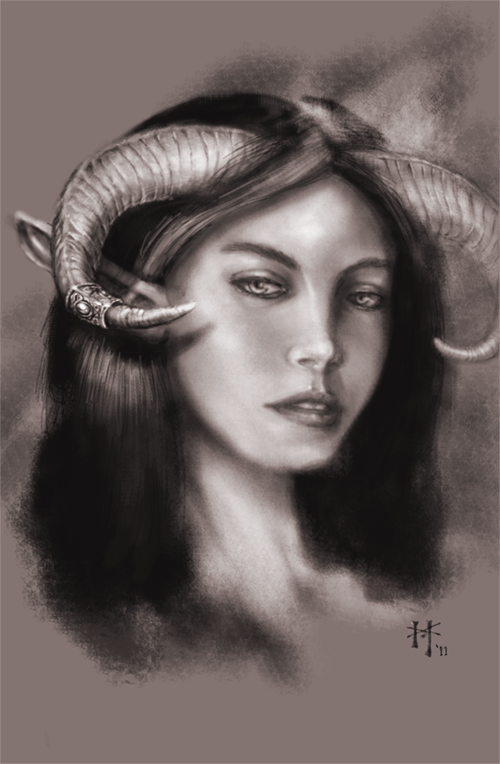
Before I go further, here's a piece I did in Photoshop to become familiar with digital drawing:

I instinctively went for a charcoal look. I did this test piece in the same manner that I would do a tonal study of a subject before I painted it. This begs the question: Why didn't I just use paper and some charcoal? It would certainly have looked better. I've seen other digital pieces where the artist has emulated everything from oils to colored pencil. Digital art is a changeling that we're never quite sure of it's original form.


I quickly came to the conclusion, after doing my digital charcoal study, that trying to emulate a physical painting medium is just a waste of time and electricity. If you want an oil painting, go paint in oil. So then what's the use of digital painting? Surely not to save us from breathing in Turpenoid or cleaning brushes (both activities are highly enjoyable for me, btw). Digital painting has it's own 'look' as distict from oils as watercolor is from pastel. Digital paint is bright and slick. It's textures overlapping shapes. It's beautiful chaos made from mathematicaly precise brushes and stock textures. It's a highly-stylized view of life, painted with light.


The real identity of digital art isn't to emulate a physical medium. Some may argue the point, but let them rant. The most basic rule of art is 'know your medium; know your tools'. You want oils? Break out the linseed and canvas. You want watercolor? Go soak your paper and prepare for many washes of color. You want slick, bright, high-tech, textures and lines assaulting your grill? Pick up the Wacom, my friend and jump into the matrix. Now, after I've spent a thousand words on this, here's a picture. Or two. Alright, here are two websites that will show you what digital art is.


http://androidjones.net/


http://artizako.cgsociety.org/gallery/